
Lithium battery supply chain innovation —
greener, better, and at a lower cost.
Producing zero-carbon, low-cost battery materials through proprietary electrolytic separation. No chemical reagents consumed. No freshwater consumption. Just electricity.
Sustainability starts at the source.
MetaGenesis is a company dedicated to bringing sustainability for the future by producing zero-carbon and low cost lithium battery materials. We operate at the heart of the clean energy transition, supplying the raw materials the world needs while setting a new standard for how they are produced.
Our proprietary electrolytic lithium extraction (ELE) technology recovers battery-grade materials from feedstocks that even conventional processes cannot economically treat. Unlike existing extraction methods, our process consumes no chemical reagents and no freshwater, and can run entirely on renewable energy — producing pure industrial-grade freshwater as a byproduct when processing brines and produced water.
By recovering critical minerals from brines, waste streams and spent batteries, MetaGenesis is positioned to become a global leader in sustainable battery material supply, and an essential strategic partner for any company serious about a lower-carbon future.
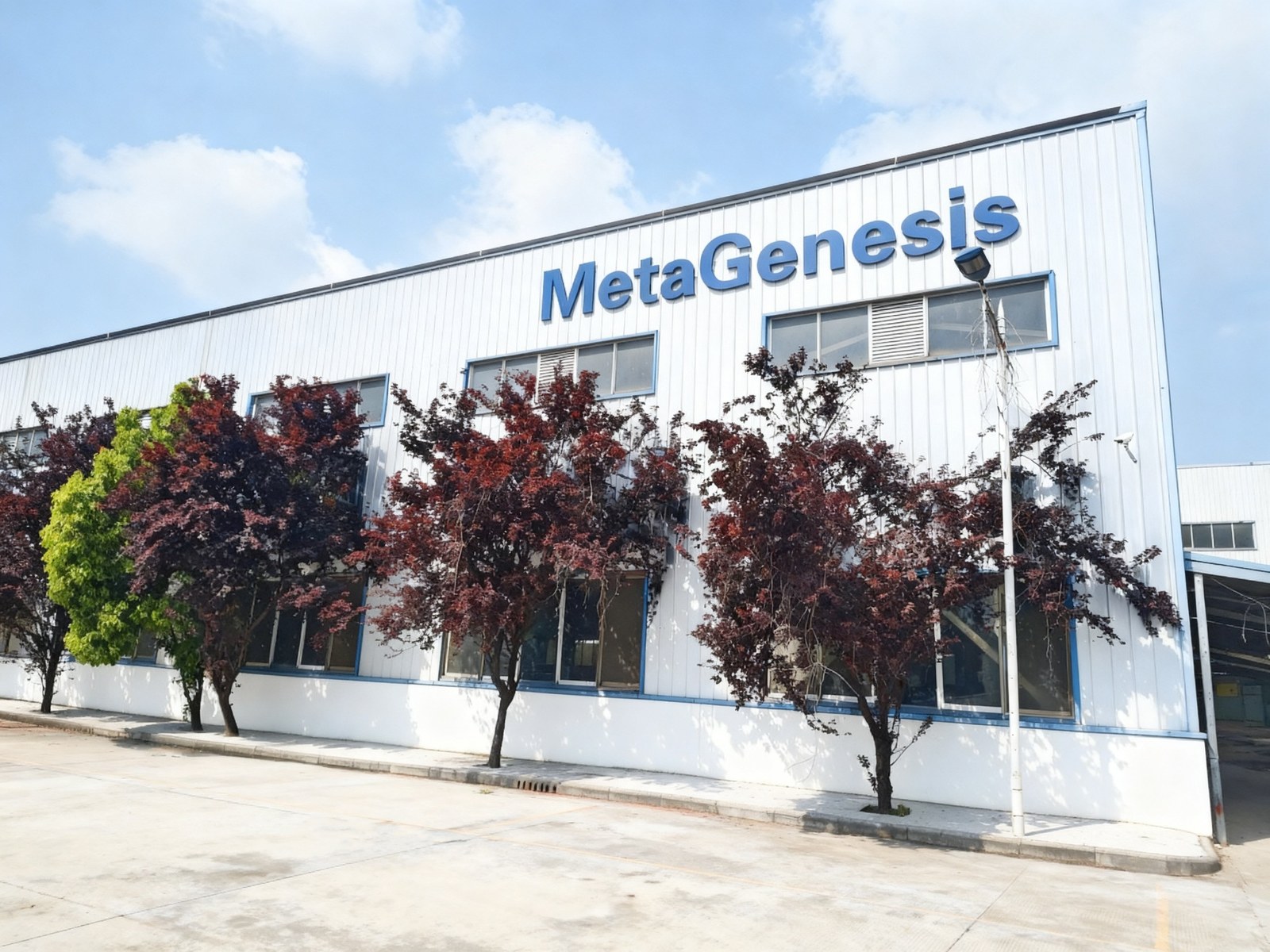
One modular solution for a variety of feedstocks and concentrations.
From high-concentration brines to ultra-low concentration produced water and even battery scrap, our system is engineered to recover battery-grade materials where conventional methods cannot economically operate.
MetaGenesis Business Segments
Focused on the Production of Zero-Carbon-Footprint Lithium Battery Raw Materials and Production Technology Solutions
Commercialised Segments
Extraction from Salt Lake Brine
Sustainable and efficient extraction of battery material from high-concentration brines.
Extraction from Oilfield Brine
Sustainable and efficient extraction of battery material from low-concentration brines.
Lithium Extraction from Battery Scrap
Closed-loop, high-value recovery of battery material from lithium-ion battery scrap.
R&D Pipeline
Solid-State Battery Materials
Research, development, and production of key material for next-generation solid-state batteries.
Our value as your partner.
Turn waste into revenue
Your produced water, or battery scrap contains minerals with real market value. We handle the recovery — you capture a new, ongoing revenue stream from a feedstock you already own.
Accelerate your ESG goals
Our zero-reagent, renewable-ready process produces battery materials with a dramatically lower carbon footprint than conventional mining — giving you quantifiable progress toward your ESG and net-zero commitments.
Proprietary, in-house technology
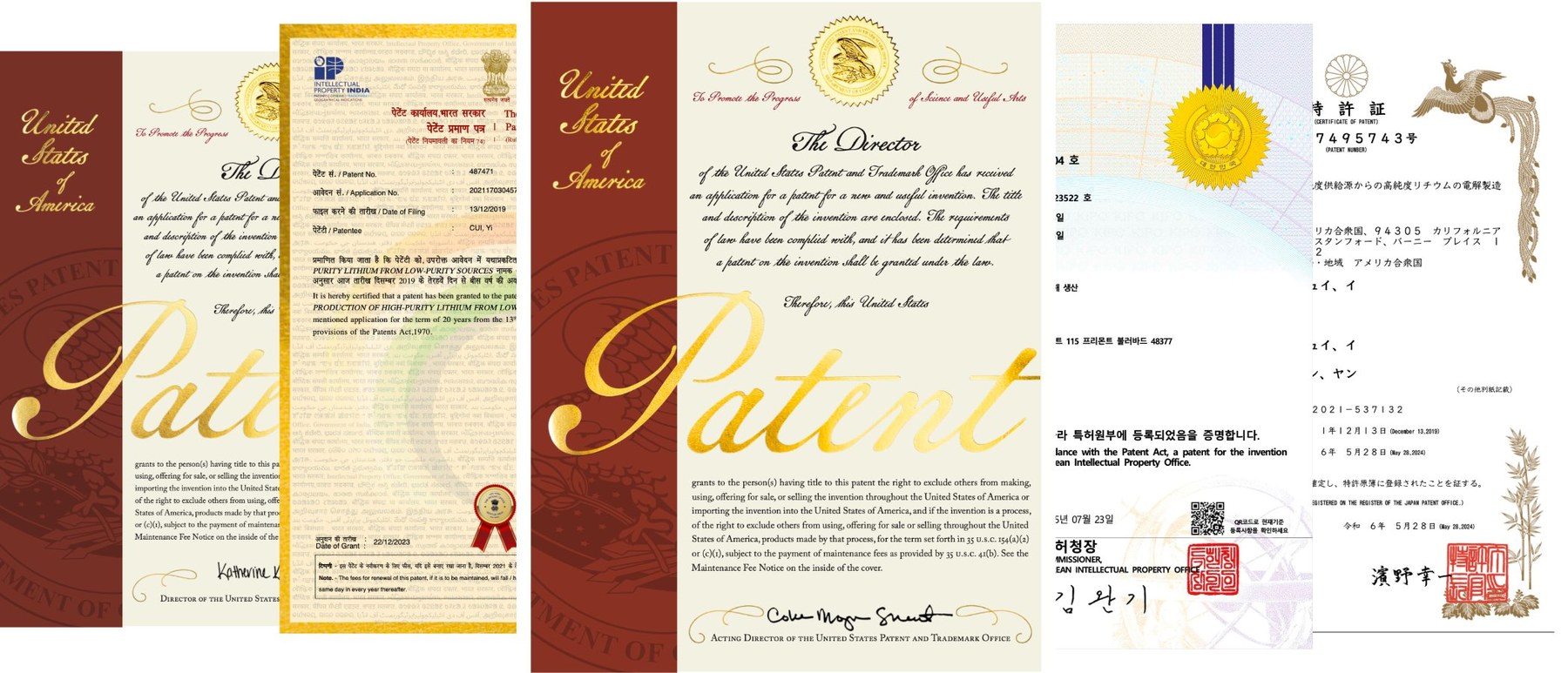
Everything we deploy is developed and owned in-house, protected by patents. No licensing risk, no third-party dependencies — and a technology moat that scales with us globally.
A Global, Robust IP Portfolio
9 Granted Patents, 28 Filed, All Invention Patents
The decarbonization race runs through lithium.
Global emissions targets are reshaping the materials economy. Demand is set to grow fivefold by 2035, and the battle for clean batteries has moved upstream — into the material itself.
Regional targets are converging — and all roads lead to lithium.
- High Impact Energy and transport together produce about half of global emissions.
- Solution A European EV emits roughly 70% less than a gasoline car across its lifetime — 63 against 235 g CO₂e per km. But the decarbonization battle has shifted upstream, to the materials inside the battery.
- Lithium Demand Set to grow fivefold by 2035 (IEA, STEPS).
The EU Battery Regulation — carbon-footprint declaration now, intensity caps to follow. Refining still consumes large volumes of acids and alkalis and leaves high-salinity wastewater behind.
Sources: Saudi Green Initiative; European Commission, European Climate Law; IEA Policies Database; IPCC AR6 WGIII (2022); ICCT (2025); Nature Communications (2024); Journal of Energy Storage (2024); Regulation (EU) 2023/1542.
Battery material — a US$202B market by 2032.
- Lithium demand is forecast to grow fivefold by 2035 as EVs and data centres scale.
- Mining alone is unlikely to meet it, and governments are racing to control supply and limit exports (China, EU, US).
Global Battery Material Market (US$B)
16.1% CAGRThe growth is not in the mine. It is in the brine and the scrap.
Measured as compound annual growth rate over 2025–2035, conventional mining expands at a fraction of the pace of the sources replacing it. Brine and spent batteries are where the market is moving — and where the extraction technology is still young enough to decide who wins.
Sources: Fortune Business Insights, Battery Material Market 2025–2032 (Sept 2026); IEA, Global Critical Minerals Outlook 2025 (STEPS); Future Market Insights, Lithium Mining Market (2026); IDTechEx, Direct Lithium Extraction 2025–2035; Global Market Insights, Li-ion Battery Recycling Market (2026).
Sustainable Lithium, redefined.
Most processes trade one burden for another — cleaner water for dirtier power, lower cost for harsher chemistry. Ours holds four conditions at the same time.
-
Zero
Chemical reagents consumed
Separation is driven electrolytically, so there is no wastewater stream and no hazardous byproduct to treat or dispose of.
-
Net positive
Freshwater balance
No freshwater is consumed. Running on brine or produced water, the process returns more clean water than it takes.
-
100%
Renewable-ready
Electricity is the only input. On renewable power the material carries effectively no process carbon.
-
Any
Feedstock composition
Adaptable across lithium concentrations and impurity profiles — including ultra-low-concentration sources no other commercial solution can reach.
Clean material is no longer a premium. Under the coming carbon caps, it is the licence to supply.
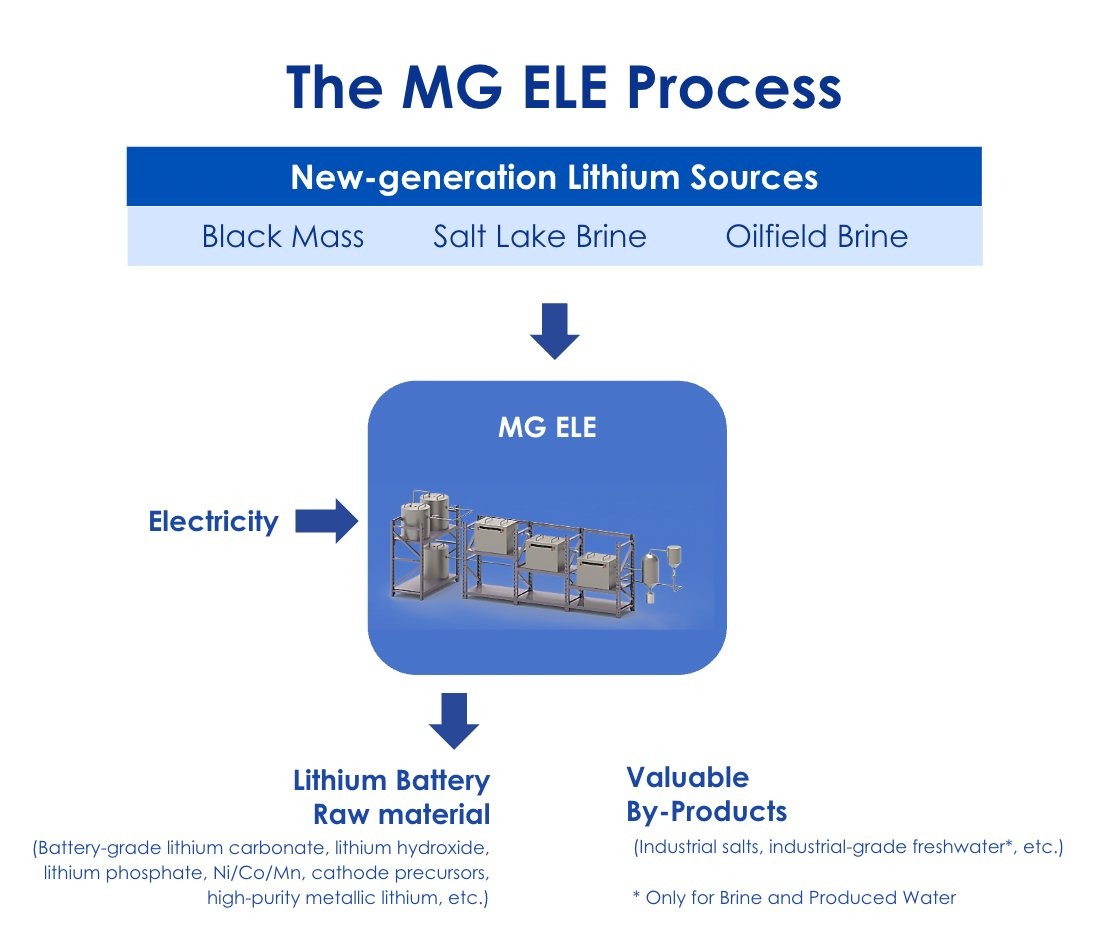
The MG ELE system — mineral recovery powered by electricity alone.
A modular electrolytic platform that produces high-purity battery materials in a single step. No reagents consumed. No wastewater. No trade-offs between sustainability and economics.
The MG ELE system.
Our modular solution ELE (Electrolytic Lithium Extraction) is not only adaptable but economically viable across a wide variety of feedstocks and lithium concentrations. Our proprietary process and system design are protected by a robust patent portfolio.
ELE enables the production of high-purity lithium products in a single step — powered solely by electricity. It eliminates costly, polluting chemical reagents and avoids complex downstream purification, resulting in a clean, streamlined process with no waste byproducts.
In simple terms, ELE unlocks lithium extraction using only electricity — delivering a zero-waste, low-cost solution. Sustainability and economic viability are no longer trade-offs, but inherently aligned.
Green-based production for zero-carbon results.
Only requires electricity
Core technology runs purely on electrical input — no thermal processing, no reagent consumption.
No chemical reagents consumed
No reagents consumed, no wastewater. Environmental advantages designed into the process from day one.
Lower operating costs
Lower OPEX + lower carbon intensity = a fundamentally more competitive supply chain.
Ultra-low concentration capable
Commercially viable at lithium concentrations no competitor can touch — unlocking new feedstocks.
High purity & recovery
Battery-grade purity in a single-step process with industry-leading recovery rates.
Modular & scalable
System architecture designed to scale from pilot to industrial production with the same proven core.
Battery-grade output, every time.
For other product inquiries, please contact us.
Battery-grade Lithium Carbonate
≥99.5% Purity (wt%)Electrolytic Nickel
≥99.5% Purity (wt%)Electrolytic Cobalt
≥99.2% Purity (wt%)Manganese Sulfate
≥98% Purity (wt%)Li-ion Solid Electrolyte
Powder, pellet, and tubeLet's build a cleaner supply chain — together.
Interested in becoming a partner, supplier, or client? Have a question? Connect with our team below.
Tell us about your project.
Fremont, CA 94538